The Defence of Europe: Can We Re-Arm in Time?”
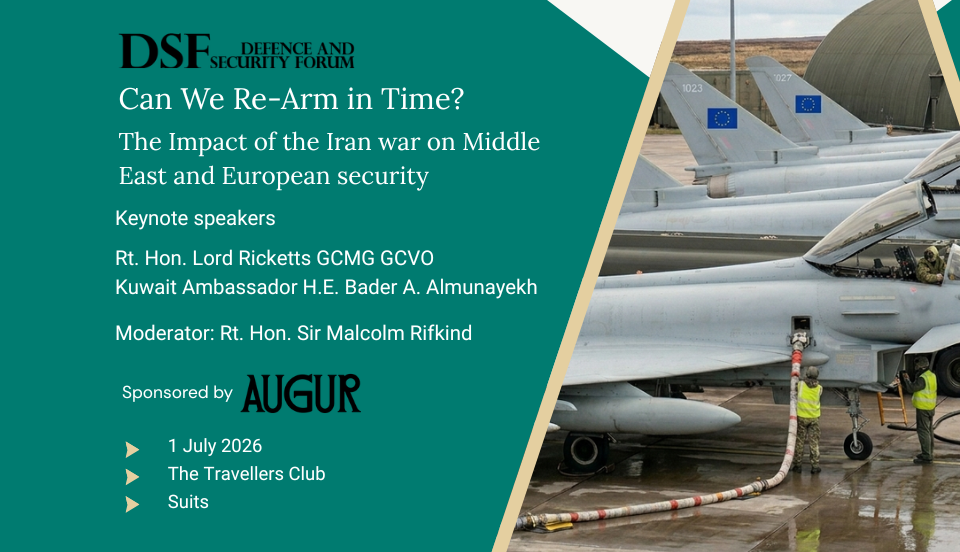
Report by Emily Claessen following a Defence and Security Forum dinner on 1 July.
Recent months have demonstrated that the UK is not immune to the risks created by the Middle East conflict: its dependence on imported energy, persistent pressure on public finances and exposure to global supply chains all increase its vulnerability to geopolitical disruptions.
The increased investment outlined in the Defence Investment Plan (DIP) has therefore been welcomed,particularly where investment is focused on technologies that have demonstrated operational effectiveness such as uncrewed aerial systems (drones), electronic warfare capabilities, and advanced intelligence, surveillance and reconnaissance (ISR) capabilities. But while the DIP represents a significant increase in defence investment, it is unclear whether the UK is prepared to sustain the long-term financial and political commitment required to restore military resilience, meet its NATO commitments, and enable a more significant expansion of defence spending. Doing so will require addressing difficult questions, including whether the public and political system are prepared to accept the costs of sustained higher defence investment.
The participation of society in this effort is indispensable: defence policy cannot succeed without broader societal resilience. Public understanding of emerging threats remains limited, despite increasing risks from sabotage, cyber-attacks, disinformation, and political interference. Through non-kinetic attacks, hostile actors can undermine our modern economies and societies without firing a shot, targeting not only systems and institutions, but also the people, communities and values at the heart of our societies.
Raw Power Is No Longer Enough
Societal resilience is even more important when we consider that the international system is undergoing major structural change. The UK finds itself in a more transactional world, the implications of which extend beyond great-power competition. This world is marked by a growing disregard for international law and established norms, leaving smaller states, whose security has traditionally depended on international institutions and collective agreements, more vulnerable than ever.
In this context, strong and enduring relationships have become essential. The long-standing partnership between the United Kingdom and Kuwait, for example, demonstrates how deep-rooted relationships can help nations protect their interests and build greater resilience. The relationship between the UK and Kuwait was built over centuries, beginning with commercial ties in 1775 and strengthened during times of crisis. From Kuwait’s support for Britain’s wartime effort during the Battle of Britain to the UK’s role in Kuwait’s liberation following its invasion by Iraq in 1990, the UK and Kuwait have repeatedly stood alongside each other when their interests and security were at stake. Today, this relationship continues to evolve, with the current instability in the Gulf showing the importance of sustained political dialogue, strong defence cooperation, and close intelligence sharing between the UK and its Gulf partners.
Meanwhile, American credibility and reliability have been weakened by a conflict that has failed to achieve its stated strategic objectives. The recent US military interventions and the strain placed on transatlantic relations have raised concerns about Europe’s long-term security dependence on the United States. For Europe, this reinforces the need to assume greater responsibility for its own defence. While NATO remains indispensable, future European security will increasingly depend upon stronger European capabilities, greater defence investment and closer regional cooperation. Achieving this will require a shift in strategic priorities: even large states can no longer only rely on superior conventional capabilities to guarantee strategic advantage. Instead, adaptability, mass production and rapid innovation have become far more important.
The recent developments in the Gulf, as well as Ukraine and the Indo-Pacific region, all point to the same broader shift. If Russia could not conquer Ukraine, and if the United States could not achieve its objectives in Iran, what happens if China invades Taiwan? China will be analysing the lessons from Ukraine and Iran very carefully.
Lessons From Iran
Iran is a strong example of why we need to look beyond conventional military capabilities. Although the 2015 Joint Comprehensive Plan of Action (JCPOA) addressed the issue of Iran’s nuclear ambitions, it did not impose limits on Iran’s ballistic missile programme or address its support for proxies, issues that continue to shape Iran’s ability to project influence. The same issues remained unresolved in the recent Memorandum of Understanding between the US and Iran, showing how difficult it is to achieve lasting stability when agreements focus only on managing immediate crises rather than addressing the underlying forces that sustain them.
But understanding Iran’s regional ambitions also requires recognising the domestic pressures shaping its strategic choices. The country’s own long-term challenge is less about confronting the United States or Israel and more about dealing with economic constraints, the social effects of 44 years of sanctions, and the needs and frustrations of its own population. How Iran manages these challenges will have consequences for the wider region, particularly for the Gulf states seeking a more stable relationship with Tehran.
Prior to the conflict, Gulf Cooperation Council (GCC) states had invested considerable diplomatic effort in rebuilding relations with Iran following years of strained engagement. That process has been significantly disrupted since the outbreak of the war. Missile attacks, drone strikes and threats to critical infrastructure demonstrated that Gulf states are no longer insulated from regional conflict. The vulnerability of airports, energy facilities, ports and maritime trade routes, particularly through the Strait of Hormuz, has reinforced the strategic importance of infrastructure resilience and the diversification of export routes through pipelines and alternative transport corridors. Yet while energy flows can be redirected, geography cannot. The Gulf states remain inescapably tied to Iran by proximity. Therefore, lasting stability will depend not only on maintaining deterrence but also on finding ways to manage relations through dialogue, diplomacy, and pragmatic coexistence.
Ultimately, the Iran war will be remembered for what it revealed about international security: that even possessing the world’s most powerful military cannot guarantee military success. As artificial intelligence, autonomous systems and precision technologies reshape war, victory will depend increasingly on states’ ability to combine military innovation with whole-of-society resilience: protecting critical infrastructure, strengthening economic security and preparing their populations for a more uncertain world.
By Emily Claessen
13 July 2026


Comments