Britain's Defence Crisis
By Lady Olga Maitland, 8 June 2026
The Most Dangerous Period in Three Decades
"The UK is in the most dangerous period I've known in my whole working life," says Air Chief Marshall Sir Richard Knighton, Chief of Defence Staff. He continued: "The risks and threats to the nation are greater now than at any time since the Cold War ended."
His went on to warn that Russia risks crossing the line, and the threat is no longer theoretical. In the first five months of this year alone, Russian strategic aircraft have repeatedly penetrated UK airspace. In May, Defence Secretary John Healey's flight over the Baltic Sea was forced to rely on alternative navigation systems after Russian jamming disabled the aircraft's GPS. Such incursions are becoming routine, not exceptional.
The flow of Russian warships and sanctioned oil tankers through British waters continues unchallenged. An average of a dozen pass each week. Yet the true vulnerability lies deeper: in the disjunction between Britain's security needs and the government's willingness to fund them.
Sir Richard was emphatic on the need for public engagement. "It is important that society and all of us recognise and understand the threat, and that may mean we need to make different choices and different priorities."
Budget Wars and Strategic Choices
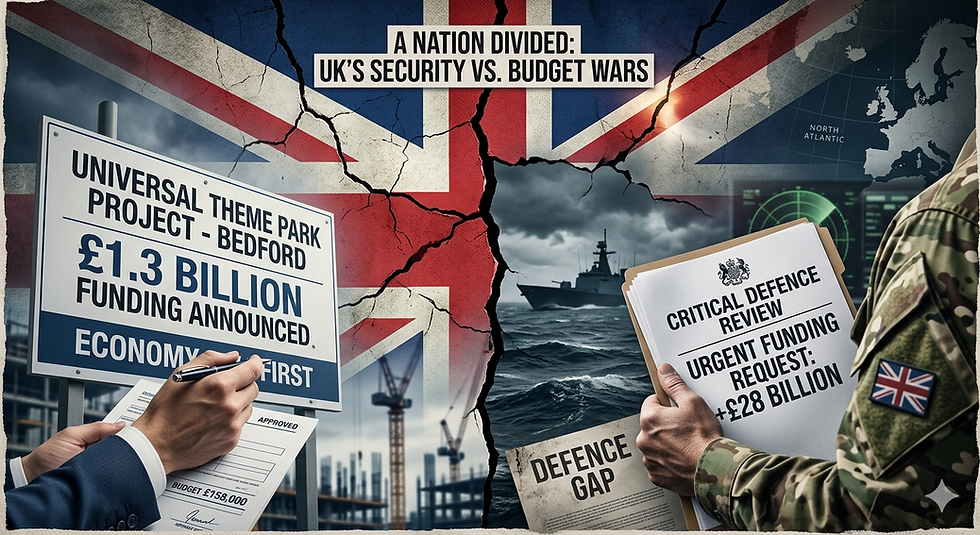
As Sir Richard made his comments ahead of the much delayed Defence Investment Plan, a "blazing row" erupted between an evidently "livid" Sir Keir Starmer, Chancellor Rachel Reeves, and Defence Secretary John Healey. The argument centred on the request for an increase in defence spending, over and above what they thought had been agreed when the Strategic Defence Review was published a year ago.
The deteriorating security environment requires an additional £28 billion to address critical shortfalls. Reeves refused to approve additional funds beyond what was already committed.
Her approach tallies with a speech she delivered at the European launch of JP Morgan's Resilience and Security programme, which aims to invest billions of dollars in defence manufacturing. Her speech was empty of defence commitments and long on rhetoric.
One defence source told Tom Newton Dunn, The Times defence correspondent: "She has money for a theme park but not to defend the nation properly? That's a strange set of priorities." Last week, the Chancellor had announced £1.3 billion in funding for a Universal theme park in Bedford, leaving the Ministry of Defence somewhat stunned.
Ireland: The Back Door to Britain
Concerns have intensified over Russian espionage operations using Ireland as a backdoor to the UK. Since Russia's invasion of Ukraine in 2022, Irish authorities have issued 14,000 visas to Russian nationals - many with minimal scrutiny.
Barry Andrews, a Fianna Fáil MEP, has been candid about the security gap: "We do not have the surveillance capacity that the UK does. I am concerned about whether we are carrying out sufficient due diligence. Unfortunately, there is quite a lot of evidence of nefarious activities by the Russians."
Alumina and Europe's Strategic Blindness
The Aughinish Alumina plant in Limerick is Europe's largest alumina refinery. Between 40% and 80% of its output travels directly to Russia - a key component in Moscow's most advanced weapons systems including Iskander-M ballistic missiles, Tsirkon hypersonic missiles, Kh-101 and Kalibr cruise missiles, as well as Shahed 136 attack drones.
The plant was founded by sanctioned Russian oligarch Oleg Deripaska through his RUSAL holding. Though his shareholding has been much reduced, he remains in control. Exports surged immediately after Russia's invasion of Ukraine began.
The European Commission has refused to impose sanctions. The Ukrainian embassy in Dublin has expressed "serious concern" regarding the continued exports. Thirty-nine MEPs from twelve countries are pressing the EU Sanctions Envoy David O'Sullivan to act. Pressure is mounting, though the Commission hides behind the argument that European aircraft and automotive manufacturing depend on the same supplies. It is a weak justification for enabling Russian rearmament.
The betting is that sanctions will eventually be imposed. But the delay has already cost Ukraine dearly.


Comments