Geopolitical poker: raw and dangerous
- noahbergman3
- Feb 1
- 3 min read

The Davos meeting was a defining moment for Europe. President Trump held the room in thrall with his bullying over Greenland. Yet in the end, it was the quiet man from Canada, Mark Carney, who delivered the pivotal insight: "The old world order is not coming back." He called for middle powers to "act together, because if we are not at the table, we are on the menu." He’s right. Great powers can afford to go it alone; they have the market size, military capacity, and leverage to dictate terms. Middle powers do not.
Alone, no European country can defend itself from a mega-power. But Europe is not powerless. Its combined economy dwarfs even that of the United States, and its population is larger. The real problem has been a complacent, power-averse mindset. We allowed the peace dividend to fund impossible levels of social welfare, which blinded us to the growing threats against our very existence.
Now, a sea change is underway. In the UK, The Times reported Ipsos poll findings of mounting public concern and deep unease about global politics—even the prospect of war. In Germany, the head of the armed forces, Lieutenant General Gerald Funke, is preparing his country for war with no "ifs" or "buts," mobilizing rapidly and activating conscription. In France, a limited voluntary military service has begun. General Fabien Mandon, Chief of the General Staff for French Armed Forces, stated, "France must be prepared to lose its children… we must be prepared for open war by 2030." President Macron has mapped 70 billion Euros to accelerate rearmament and "stand ready if we are faced with war."
As for the UK’s own defence planning…? I think we should be told.
Lord Robertson, former Secretary General of NATO and chairman of the UK Strategic Defence Review, echoed these concerns at a London security conference last week: "We are in troubled times, which is an understatement. Here we are, underprepared, under-insured, and under attack." Indeed, the UK faces daily assaults - cyber attacks, espionage, arson, jamming of aircraft and naval systems, and manipulation of public attitudes.
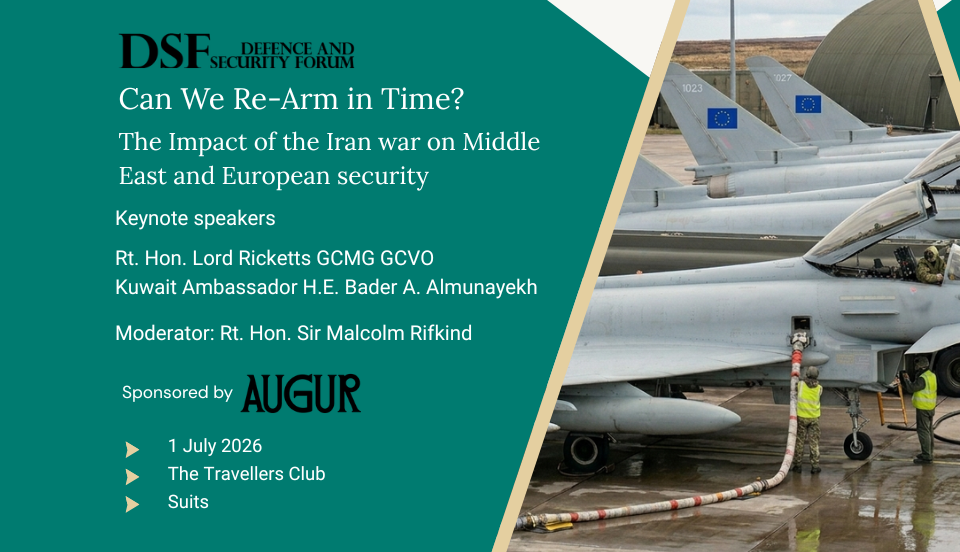
An encouraging note, however, was struck by retired US Rear Admiral Mark Montgomery at last week's Defence and Security Forum. Regarding Ukraine, he said, "Ultimately, I believe they will prevail. Their military resilience is very strong, despite all that is against them. They have a manpower problem but much better training; their survival rate is far higher than the Russians'. Overall, I do not think they will break." A comment from Audere International, which maintains a major office in Kyiv, aligns with this: "We expect the war to continue into 2027."
China
Prime Minister Keir Starmer has done what he can to recalibrate relations with President Xi during his State Visit. But as Isobel Hilton, Founder of the China Dialogue Trust, noted at a London security conference, "The fact is that he had little leverage…" is key. Despite bullying from President Trump, who threatens increased tariffs, Sir Keir had no choice but to engage with China - unpalatable as much of their system is. Britain imports more from China than we export; China is a global superpower and, as things stand today, more predictable than the United States.
Iran
Unexplained gas explosions have broken out simultaneously in five cities - hardly a coincidence. Meanwhile, President Trump has stalled his threatened attacks on nuclear facilities as discreet talks, mediated by Turkey, take place in Ankara. Iranian and US officials began meeting last weekend. My Iranian source tells me the interesting aspect is that Iranian officials have decided to proceed with negotiations, ignoring Supreme Leader Khamenei, who has banned such contact. This is a sign his position is weakening. There is also an expectation that those close to him may shuffle away to protect their vast financial interests if a rift or collapse in the regime seems imminent.
The danger, as ever, is miscalculation, and how a face-saving climb-down can be achieved. Or, as Professor Peter Frankopan said today, "This is geo-political poker at its most raw and dangerous."


Comments